What Analytical Method Validation Shows for an Intended Use
Assess a validation summary by its purpose, sample matrix, reportable range and demonstrated performance.
Method validation documents performance for an intended measurement, sample type and range. For a peptide test, look for evidence about the relevant interferences, agreement with a reference, repeatability and the reporting range. Routine system suitability checks address whether a particular run met its predefined checks.
Identify the intended use first
Start with the question the procedure was designed to answer. An LC–MS identity comparison, an HPLC impurity procedure and an assay reporting milligrams per vial can use overlapping instrument capabilities while requiring different validation evidence. Record the analyte or attribute, sample matrix and preparation, reportable unit and expected range. If the method was studied on neat peptide powder, ask what evidence applies to a vial containing added components that may affect preparation or signal.
Eurachem’s 2025 guide discusses fitness for purpose, validation and verification across analytical laboratories. FDA’s ICH Q2(R2) guidance provides a framework for pharmaceutical analytical procedures. Its examples tie performance characteristics to what the procedure will report.
ICH Q2(R2), Validation of Analytical Procedures, corrected April 2025 · Eurachem, The Fitness for Purpose of Analytical Methods, 3rd edition
Read the results behind each characteristic
Selectivity evidence shows how well the method distinguishes the target measurement from relevant interference. In a chromatographic impurity test, look for studies with likely interfering compounds or appropriately characterized mixtures. Accuracy in the ICH validation context concerns agreement with a suitable reference or known added amount. A spike recovery study is more informative when the test includes the sample matrix and the relevant preparation steps.
Precision describes agreement between repeated results under specified conditions. Repeated injections from one preparation mainly show variation within the injection and measurement stage. Separate sample preparations include additional preparation variability. A study that varies days, analysts or instruments within a laboratory can address intermediate precision under the conditions it actually includes. Robustness addresses the effect of deliberate variation in procedure parameters, such as column temperature or mobile-phase composition where relevant.
The working range refers to levels presented to the instrument. The reportable range concerns the final analytical result and may depend on steps such as dilution and a calculation back to the original sample. Ask whether the stated range uses the same unit and basis as the result you are reading.
ICH Q2(R2), Validation of Analytical Procedures, corrected April 2025 · Eurachem, The Fitness for Purpose of Analytical Methods, 3rd edition · ICH Q14, Analytical Procedure Development
Check whether the validation covers a borderline result
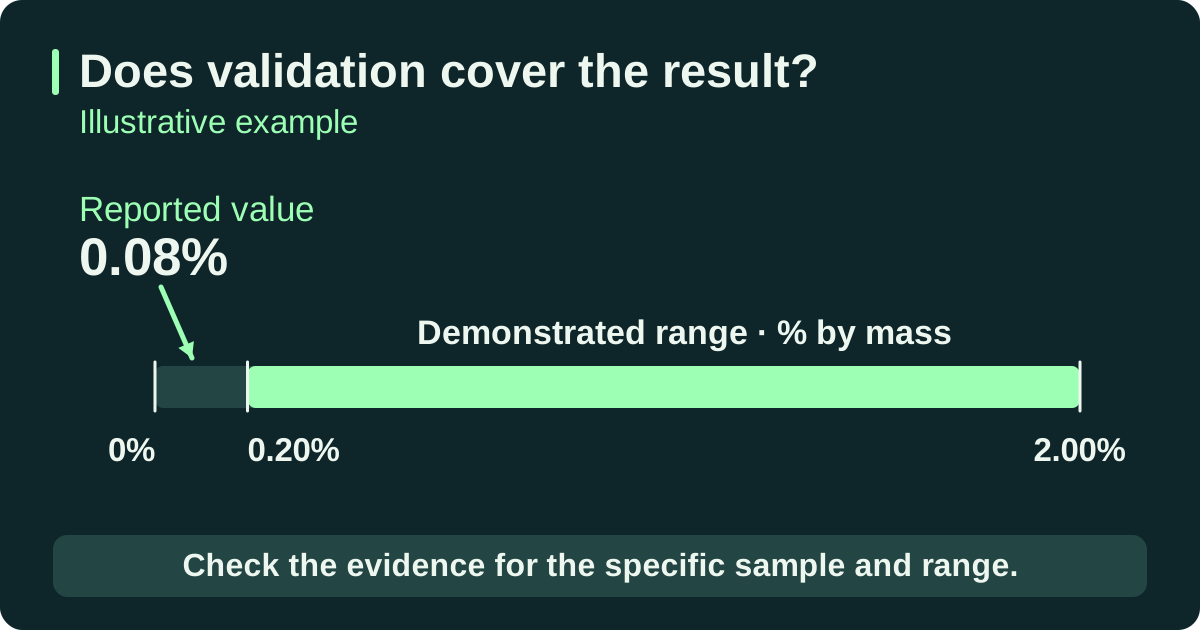
Suppose a fictional peptide impurity method has a reportable range of 0.20% to 2.00% by mass in a specified powder matrix. A reported 0.08% value falls below the range demonstrated in that summary. Ask whether another method or supporting study justifies the numerical value, or whether the procedure uses a qualified result at that level. If the study needs to distinguish 0.08% from 0.12%, the documented quantitative range needs to cover that decision.
A routine check such as a reference injection and a minimum resolution for a critical peak pair can show that the run met those particular criteria. For a new matrix, changed procedure or transferred method, ask what verification, transfer or additional validation evidence covers the change. Save the procedure ID and revision, range, test matrix, key validation results and relevant run checks. Record the nearest boundary or open question alongside any conclusion about applicability.
| Intended use | Sample or matrix | Performance characteristic | Documented range or scope | Evidence and what to ask next |
|---|---|---|---|---|
| Quantify a specified HPLC impurity | Peptide powder prepared by method IMP-01 | Selectivity, accuracy and precision | 0.20–2.00% by mass in the original powder | Validation summary cites interference and recovery studies in the powder. If the report shows 0.08%, ask for a documented range that includes that level or supporting evidence from an applicable procedure. Ask how the lab qualifies results outside the demonstrated range. |
| Compare an LC–MS intact mass with a reference | Prepared peptide solution, documented charge and adduct | Mass accuracy and selectivity | Intact-mass comparison for the stated reference and preparation | Request the reference spectrum and documented mass tolerance. Sequence assignment would require appropriate additional evidence, such as informative fragments. |
| Measure peptide amount per finished vial | Reconstituted vial with the stated excipients | Accuracy, precision and reportable range | 4.0–6.0 mg peptide equivalent per vial in this example | Look for calibration and recovery data with the vial matrix and preparation. Ask for supporting evidence if the vial formulation changes. |
Record the method revision alongside the tested matrix, reporting basis and evidence. The operating range of an instrument and the reportable range of the complete procedure describe different stages of the measurement.
ICH Q2(R2), Validation of Analytical Procedures, corrected April 2025 · ICH Q14, Analytical Procedure Development